|
Early days yet, but since we have it already we'll put it up here. The Conference Group on Taiwan Studies (CGOTS) call for papers is up for the 2019 annual meeting of the American Political Science Association (APSA), to be held August 29-September 1 in Washington, DC. The APSA conference theme is "Populism and Privilege." Our official Related Group call for papers is reposted below; it's also available in pdf format here. The deadline for submissions is Tuesday, January 15 at 11:59pm Pacific Standard Time. 2019 American Political Science Association Conference Group on Taiwan Studies (CGOTS) Call for Papers The 2019 American Political Science Association (APSA) Annual Meeting will be held from August 29 to September 1, 2019, in Washington, DC. The conference theme is “Populism and Privilege”
CGOTS invites paper and panel proposals on Taiwan’s domestic politics, cross-Strait issues, and international relations that are consistent with the theme of “Populism and Privilege.” No recent political development has been more striking than the rise to power of self-identified populist movements around the globe, whose main unifying trait is their claim to champion “the people” against entrenched selfish “elites.” These movements display differences that have sparked debates over which, if any, should be called “populist”; how they compare with past “populisms”; and what “populism” is. The current partisans, often labeled populist, have more often been on the right than the left, including anti-immigrant, anti-globalization, ardently nationalist parties such as Fidesz in Hungary; the Law and Justice Party in Poland; and the Trump Republicans in the United States. Until recently, however, left-wing populist movements were ascendant in Latin America. In fact, they remain important there and in other regions, something suggested by support for Bernie Sanders in the 2016 American primaries. Some positions increasingly labeled as populist, such as the ruling regime across the Strait, the Chinese nationalism of Xi Jinping, represents forms of state capitalism that are harder to identify on either the left or right. Indeed, modern “populist” movements have a wide variety of economic agendas, even as most push against the leading institutions of the global economic order, such as the IMF, the World Bank, and multilateral trade agreements. Some, such as in Erdogan’s Turkey and Mohdi’s India, are stridently religious; others, like the anti-immigrant populisms in Europe and the United States, often feature racial and cultural themes. When comparing Taiwan to other established or even newly established democracies, the level of populism in Taiwan is considerably mild. But the 2014 Sunflower Students Movement and other social movements such as the one against the revision of labor rights law during Tsai Ing-wen’s early administration, are signs of the rise of populism. For the 2019 Annual Meeting, we encourage participants to consider questions about “Populism and Privilege” in Taiwan, especially those that speak to the strengths and weaknesses of Taiwan’s democracy under the theme perspective, and to various domestic and international issues related to threats imposed by the Chinese populist regime. These topics could include research about the emergence of populist movements among citizens through studies of public opinion and social media, the relations between political parties and their strategies during electoral campaigns, changing of social issues and policies on immigration, trade, labor rights, and minorities after DPP regained power in 2016, and the dynamics of ideological shifts within more than two decades of Taiwan’s democracy. The next general local election in Taiwan is scheduled in December, 2018. How will the electoral outcome change the landscape of Taiwan’s political composition, and how will the existing social issues, such as rising inequality, stagnant wages, and an aging society be managed? How will the issues related to social justice and gaps between elites and commons play a role in this election, and how these issues will be altered after the election? We would also especially welcome proposals that utilize innovative approaches to understand how China factor influences Taiwan’s politics, cross-Strait relations, and Taiwan’s role in the global society. How would and will the ongoing trade war between China and the United States affect the role of Taiwan in the current US-China relations? How would and will the changing dynamics of the relations between North Korea and the United States influence Taiwan through the perspective of global and East Asian regional security? How would and will the power/party alternation from Ma Ying-jeou (KMT) to Tsai Ing-wen (DPP) alter the cross-Strait relations? What is the impact of Tsai’s New Southbound Policy on Taiwan’s economic performance and what will be the future direction of it? Other related proposals aim to address Taiwan’s international status and the US-Taiwan relations are strongly encouraged as they provide profound implications to policymakers in both Taiwan and the United States. Please send proposals to APSA: (https://convention2.allacademic.com/one/apsa/apsa19/) If you have any questions or concerns, please contact Yao-Yuan Yeh ([email protected]), CGOTS Coordinator. Travel support for CGOTS panelists is subject to the availability of external funding.
3 Comments
At the 2018 annual APSA meeting, the Conference Group on Taiwan Studies membership endorsed a new leadership team for the coming year.  The new Coordinator of CGOTS is Yao-Yuan Yeh 葉耀元 (Ph.D. Texas A&M, 2014). Dr. Yeh is currently an assistant professor in the Center for International Studies at the University of St. Thomas in Houston, Texas. He previous taught in political science department at UC Merced. His research focuses on political attitudes in authoritarian countries, political violence, and Taiwanese and Chinese studies, and his teaching interests include international studies, comparative politics, and research methods. His work has appeared at Social Science Quarterly, China Quarterly, Terrorism and Political Violence, and British Journal of Political Science.  The new Deputy North American Coordinator is Dennis Lu-cheng Weng 翁履中 (Ph.D. University of Texas at Dallas, 2014). Dr. Weng is an assistant professor in the Department of Political Science at Sam Houston State University in Huntsville, Texas. Prior to joining SHSU, he taught at Wesleyan University and SUNY-Cortland. Dr. Weng’s research and teaching interests are in the fields of comparative politics, Asian Politics, political behavior, and survey research. His articles have appeared in Electoral Studies, Japanese Journal of Political Science, Asian Journal of Comparative Politics, Asian Journal of Political Science, Journal of Southeast Asian Studies, and several news media outlets in Asia.  The new Deputy Taiwan Coordinator is Shiau-chi Shen 沈筱綺 (Ph.D. Columbia University, 2013).
Dr. Shen is an assistant professor in the Department of Political Science at National Soochow University in Taipei, Taiwan. She previously taught at National Tsing-hua University in Hsinchu. Her research and teaching interests are in the fields of comparative politics, public opinion, national identity, and political participation.  This year's American Political Science Association annual conference will take place in Boston, MA, from Thursday, August 30 to Sunday, September 2, at the Hynes Convention Center in the Back Bay neighborhood.
We encourage all APSA attendees to drop by the Conference Group on Taiwan Studies reception, Thursday, August 30, from 7:30-9:00pm in Marriott Salon K. Free (!!!) drinks and hors d'oeuvres will be served. All CGOTS members are also invited to attend our annual business meeting, to be held right before the reception from 6:30-7:30, next door in Marriott Salon J. We'll go over budget and membership numbers and nominate the new CGOTS leadership team. Please also check out the three official CGOTS panels, as well as other Taiwan-related presentations at the conference; details can be found here. 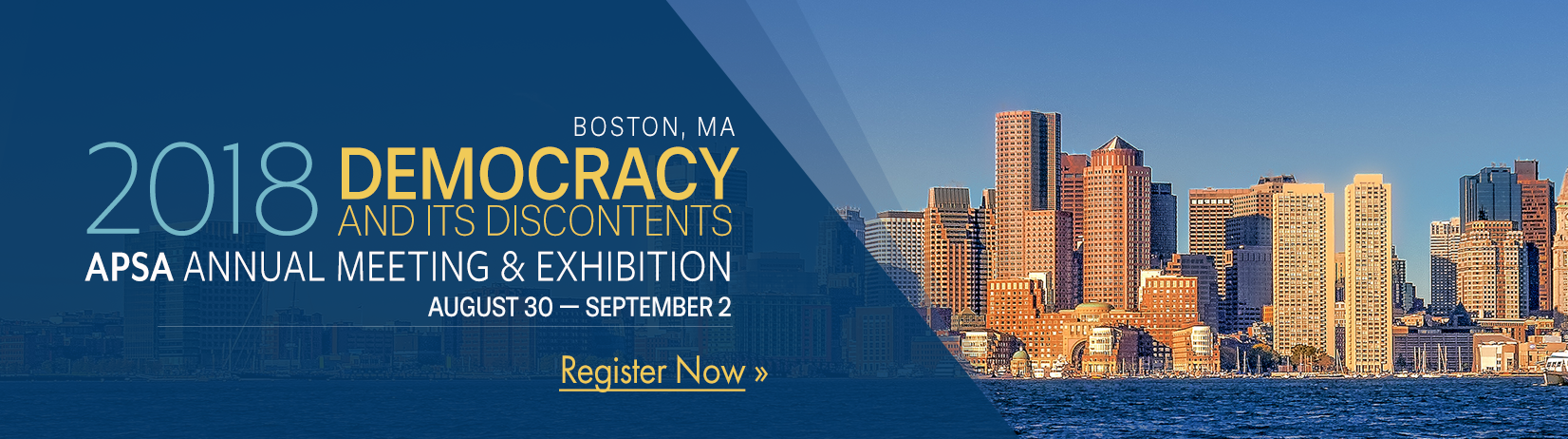 The Conference Group on Taiwan Studies is a special Related Group of the American Political Science Association. For this year's annual APSA conference in Boston, CGOTS is hosting three panels, a business meeting, and a reception. All are open to registered conference participants. Details can be found below, and will be updated as the conference approaches. Thursday, August 302:00-3:30pm, Sheraton, Beacon H CGOTS Panel I. Support for Democracy in Taiwan Chair: Howard Sanborn, Virginia Military Institute 1. "Does Inequality Hurt Democracies?: Evidence from East Asian Democracies," Yi-tzu Lin, University of South Carolina 2. "Polarization Perception and Support for Democracy: The Case of Taiwan," Yi-ching Hsiao, Tamkang University; Eric Chen-hua Yu, National Chengchi University 3. "Political Trust and Civil Disobedience: Evidence from Taiwan," Tzong-Jyi Lin, Tamkang University Yi-ching Hsiao, Tamang University Yi-Bin Chang, Tamkang University Ching-Hsing Wang, University of Houston Dennis Lu-cheng Weng, Sam Houston State University 4. "The Dilemma of Democratic Governance in a Divided Society: The Case of Taiwan," John Fuh-sheng Hsieh, University of South Carolina Discussants: Wei-ting Yen, Ohio State University; Howard Sanborn, Virginia Military Institute 4:00-5:30pm, Marriott, Brandeis CGOTS Panel II. Taiwan Security and Foreign Policy Chair: Yao-yuan Yeh, University of St. Thomas 1. "Donald Trump's Global Leadership in Asia," Chung-li Wu, Academia Sinica; Ching-ching Chang, National Chengchi University 2. "Taiwan and China in the U.S. Congressional Legislation: Who Supports It and Why?" Kuang-shun Yang, Arizona State University 3. "The Elephant and the Little Dragon: Prospects of India-Taiwan Relations," Vincent Wei-cheng Wang, Ithaca College 4. "Will Democracy Identity Strengthen Defense Commitment?: Taiwan as a Case," Szu-chien Hsu, Academia Sinica; Shiau-chi Shen, Soochow University Discussants: Chien-kai Chen, Rhodes College; Shelley Rigger, Davidson College 6:30-7:30pm, Marriott, Salon J CGOTS Business Meeting 7:30-9:00pm, Marriott, Salon K CGOTS Reception Friday, August 318:00-9:30am, Marriott, Regis CGOTS Panel III. Courts and Parties in Taiwan Chair: Da-chi Liao, National Sun Yat-sen University 1. "Partisan Network and Sustainability of Party System in Taiwan: A Network Analysis," Karl Ho, University of Texas, Dallas Lauren Ratliff Santoro, University of Texas, Dallas Kuan-chen Lee, Center for East Asia Democratic Studies 2. "Party Image and Electoral Behavior in Taiwan," T.Y. Wang, Illinois State University Su-feng Cheng, National Chengchi University 3. "Reexamining the Role of the Constitutional Court in Taiwan’s Democratization," Chin-shou Wang, National Cheng Kung University Yu-hsien Sung, University of South Carolina 4. "The Effect of Democratization on Constitutional Norms," Jason Kuo, University of California, San Diego Wei-Chih Chen, Rutgers University Discussants: Jinhyeok Jang, National Sun Yat-sen University; Hans J. Stockton, University of St. Thomas Dynastic Politics and Democratic Discontent "Do Ordinary People Dislike Dynastic Politicians?: Evidence from Taiwan" Nathan F. Batto, Academia Sinica Ying-lung Chou, Tamkang University 12:00-1:30pm Beyond Audience Costs: Signaling in International Security "Certain Uncertainty: Arms Transfers and Strategic Ambiguity in the Taiwan Strait," Jennifer Spindel, University of Minnesota 2:00-3:30pm Clientelism in New Democracies "Democratic Linkage-Building in East Asian Democracies" Eric C.C. Chang, Michigan State University Saturday, September 18:00-9:30am The Science of Empires: Non-Western Colonialisms in Comparative Perspective "What Time is it There?: Formosa's Historical Status in Chinese Colonial Discourse," Leigh K. Jenko, London School of Economics Nuclear Stratey in Asia “Nuclear Deterrence Theory in Asia: Ideational Beliefs and Nuclear Strategy” James Turner Simpson, Boston University 10:00-11:30am Mixed Methods Research in the Developing World "Analysis of Tsai Ing-wen’s Campaign through a Gender Lens" Young-Im Lee, California State University, Sacramento Chinese Foreign Policy in a New Era: Concepts, Measures, and Empirical Evidence "Accommodation in the Shadow of Hierarchy: Which Countries Welcome China's Rise?" Scott Kastner, University of Maryland Evan Jones Extended Security Commitments and Power Projection "Alliances and Escalation in the Nuclear Age" Caitlin Talmadge, George Washington University 12:00-1:30pm Chinese and American Grand Strategies: Implications for National Security "Should the United States Compete or Cooperate in Response to China's Rise?" Charles L. Glaser, George Washington University The Use, and Sometimes Failure, of Economic Sanctions "A Rusty but Provocative Knife?: The Rationale behind China's Sanction Usage" Weihao Huang, Rutgers University 4:00-5:30pm Perceptions of China "Measuring and Explaining Threat Perception toward China: Evidence from Taiwan" Ronan Tse-min Fu, University of Southern California Migration Governance in Colonial, Postcolonial, and Developing States "Citizenship, Immigration, and the Developmental Migration State in East Asia" Erin Aeran Chung, Johns Hopkins University Yunchun Tien, Johns Hopkins University Nationalism and Status in World Politics "Who Bargains?: Status, Nationalism, and the Politics of Compromise" George Yin, Harvard University Sunday, September 28:00-9:30am
Policy Choices and Regime Survival in Dictatorships "Infrastructural Capacity and Regime Transition: Evidence from Kuomintang" Peng Hu, Fudan University Methods for Public Opinion Data "A Bayesian Bivariate Ordered Probit Analysis of Attitudes towards Immigration" Tsung-han Tsai, National Chengchi University Chi Huang, National Chengchi University Chia-hung Tsai, National Chengchi University 10:00-11:30am The Dynamics of Extended Nuclear Deterrence: New Theories and Evidence "When Nuclear Umbrellas Work: Signaling Credibility in Security Commitments" Neil Narang, University of California, Santa Barbara  The Conference Group on Taiwan Studies new website is live! Our first announcement is our call for paper proposals for the 2018 American Political Science Association Annual Conference, to be held in Boston, MA, August 30-Sept 2, 2018. The deadline for submission is January 16, 2018. Please see below for details. As a Related Group, CGOTS has a separate review process for our limited panel allotment. To maximize the number of Taiwan-related papers across the annual conference, we encourage applicants to submit their paper proposals to another division first, and to list CGOTS as your second choice division; we will look especially favorably during our review on proposals that have not been accepted at other Divisions or Related Groups and have been transferred to us. Conference Group on Taiwan Studies Call for PapersThe 2018 American Political Science Association (APSA) Annual Meeting will be held from August 30 to September 2, 2018, in Boston, Massachusetts. The conference theme is “Democracy and Its Discontents.”
CGOTS invites paper and panel proposals on Taiwan’s domestic politics and cross-Strait and international relations that are consistent with the theme of “Democracy and Its Discontents.” These are challenging times for democracy around the world. In many established democracies, the aftermath of the 2008 and the 2011 economic crises is opening up new spaces for new challengers and popular grievances. The complex relationship between national systems of rule and a global economy is leading to greater tensions both within democracies and between them. Existing rules and party systems are under strain as new cleavages emerge, with populism, nativism, and illiberalism all jostling for popular support, as well as new experiments in representation. Developed democratic systems are experiencing greater discontent among voters. Global flows of people, capital, and investment undermine national identities and institutional arrangements. At the same time, there are challenges to the legitimacy of international institutions that are seen as limiting economic and democratic choices. For the 2018 Annual Meeting, we encourage participants to consider questions about “Democracy and Its Discontents” in Taiwan, especially those that speak to the strengths and weaknesses of Taiwan’s democracy, its political transformation in recent decades, and the domestic and factors that continue to influence its politics. These could include questions about shifts in Taiwanese public opinion: has it become less polarized, for instance, on questions of national identity and cross-Strait relations, and how do those differences relate to age, gender, and socioeconomic status? Do Taiwanese citizens by and large still support democratic ideals, and are they happy with how democracy is working? Taiwan’s domestic political economy is another topic with comparative relevance: for instance, what are the causes and consequences of rising inequality, stagnant wages, an aging society, and its shifting place in international economic relations? Taiwan has thus far been spared much of the illiberal populist backlash that has led to political upheaval in many other democracies, young as well as old: but why? For how long? With what consequences for Taiwan’s party system, its electoral politics, and the quality of its democracy? More concretely, was the increase in social mobilization that culminated in the Sunflower Movement in 2014 a backlash against broader forces of globalization, a narrower concern about cross-Strait relations and national identity, or some combination of the two? We would also especially welcome proposals that consider in innovative ways the evolution of the China factor in Taiwan’s politics. In what ways has the PRC’s influence changed over recent years? What have been the long-term consequences of its deepening economic ties to the island and the increasing exchanges of people and goods across the Taiwan Strait—particularly those occurring as a result of agreements signed during the Ma Ying-jeou era? Proposals might also address the abrupt changes in cross-Strait dialogue now that a DPP government is back in power and Beijing has given it the cold shoulder, or the other regional and international opportunities and challenges facing the Tsai administration, including relations with the new administration in the United States. Please submit proposals to APSA: (https://connect.apsanet.org/apsa2018/) no later than January 16, 2018. If you have any questions or concerns, please contact Kharis Templeman ([email protected]), CGOTS Coordinator. Travel support for CGOTS panelists is subject to the availability of external funding. |
AuthorThis blog is maintained by the CGOTS coordinator, Austin Wang Archives
October 2025
Categories |
 RSS Feed